
Francisella Species and Summary Model
Product Code : JC-BE-6197
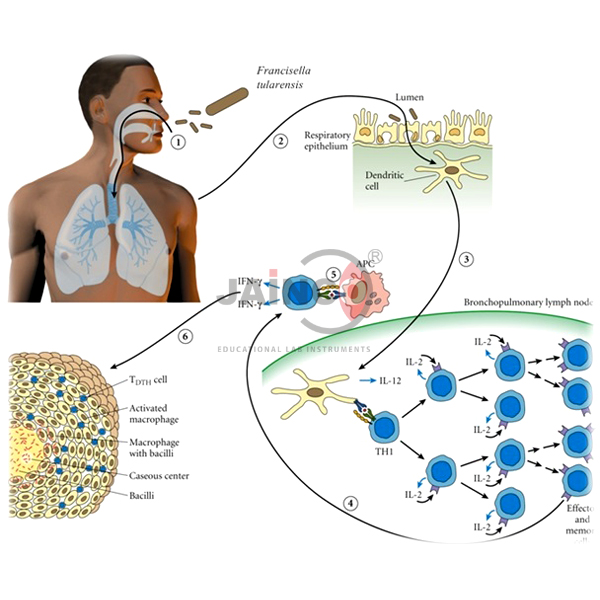
The Francisella Species and Summary Model (SKU JC-BE-6197) is a Francisella tularensis model that summarises this small, Gram-negative, intracellular coccobacillus and the disease tularaemia. It shows how few organisms are needed to cause infection, the routes of spread through tick and deer fly bites, contact with infected animals such as rabbits or inhalation, and the ulceroglandular and pneumonic forms. It is used in medical microbiology teaching. JaincoLab manufactures it in Ambala, India.
Specifications
The model is a microbiology teaching model of Francisella tularensis, covering the organism, its infectivity, the transmission routes and the ulceroglandular and pneumonic forms of tularaemia; its dimensions, material and base are not in the current product data and are confirmed on the quotation.
| Product | Francisella Species and Summary Model |
| SKU | JC-BE-6197 |
| Model type | Microbiology teaching model |
| Subject depicted | Francisella tularensis and the forms of tularaemia |
| Topics shown | Francisella tularensis as a small intracellular coccobacillus, its high infectivity, tick, deer fly, animal-contact and inhalation routes, and the ulceroglandular and pneumonic forms |
| Size, material and base | Confirmed on the quotation |
Uses of the Francisella tularensis model
Teachers use the model to introduce a zoonotic infection that reaches people by several routes and to show how the route of entry shapes the form the disease takes.
- Describing Francisella tularensis as an intracellular coccobacillus
- Explaining its high infectivity from a small inoculum
- Tracing spread by ticks, deer flies, animal contact and inhalation
- Comparing the ulceroglandular and pneumonic forms
- Medical microbiology and zoonosis teaching
Scope of supply and ordering
Each unit is a single Francisella Species and Summary Model depicting Francisella tularensis and the forms of tularaemia, supplied for classroom and laboratory teaching. Construction details not listed above, and any accessories, spares and quantities, are confirmed on the quotation.
Frequently asked questions
Which forms of tularaemia does the model show?
The ulceroglandular form, with a skin ulcer and swollen regional lymph nodes, and the pneumonic form that follows inhalation of the organism.
Which transmission routes are covered?
Tick and deer fly bites, contact with infected animals such as rabbits, and inhalation.
Related products
- Bordetella Pertussis and Disease Model
- Yersinia Pestis and Species Model
- Epidemiology and Pathogenesis of Plague Model
- Bacterial Families Model
More models of this type are listed in the JaincoLab biology lab equipment range.
Request a quote
Request pricing for the Francisella Species and Summary Model (SKU JC-BE-6197) through the JaincoLab contact page, stating the number of models and where they are to be delivered, or write to [email protected]. Tender and project enquiries can be sent through the tenders page.


