• +91-85699-09696

Replication Cycle of Viruses Model
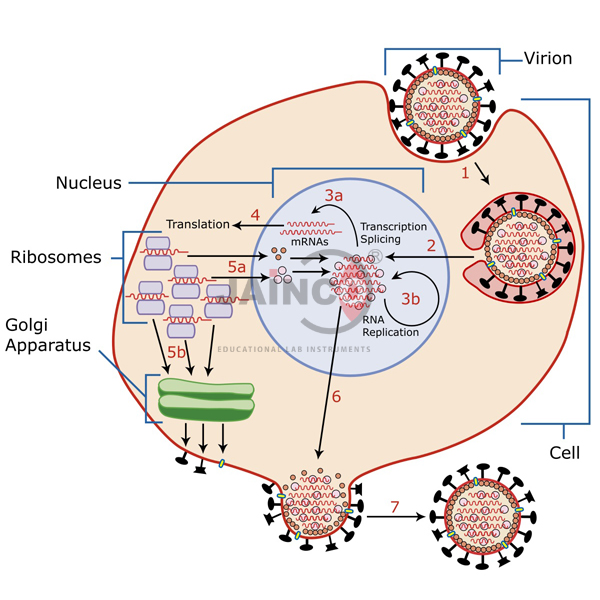
Replication Cycle of Viruses Model

Product Code : JC-BE-6214

The Replication Cycle of Viruses Model from Jaincolab is an educational chart designed to help students of microbiology, virology and molecular biology visualize how viruses multiply inside a host cell. Since viruses are obligate intracellular parasites lacking their own metabolic machinery, they depend entirely on the host cell to complete each stage of replication, and this model presents that stepwise process — attachment, penetration, uncoating, biosynthesis, assembly and release — in a clear, sequential, labelled diagram.

As a dependable biology lab equipment supplier in India, Jaincolab designs this model to build a strong conceptual foundation for how both lytic and lysogenic replication strategies unfold, supporting classroom teaching, practical demonstration and revision for microbiology and virology courses at school and college level.

What the Concept States

ParameterDetails
Stage 1: Attachment (Adsorption) Virus binds to specific receptor molecules on the host cell surface, determining host and tissue specificity
Stage 2: Penetration Viral genome (or the whole virion) enters the host cell by injection, membrane fusion, or endocytosis
Stage 3: Uncoating Viral capsid is removed, releasing the viral genetic material (DNA or RNA) into the host cell
Stage 4: Biosynthesis Host cell machinery is redirected to replicate viral nucleic acid and synthesize viral proteins
Stage 5: Assembly (Maturation) Newly synthesized viral genomes and capsid proteins are assembled into complete virus particles
Stage 6: Release Mature virions are released from the host cell by lysis (lytic cycle) or budding, often destroying the host cell
Alternative Pathway Illustrated Lysogenic cycle, in which viral genetic material integrates into the host genome as a prophage before later entering the lytic cycle

Key Features

  • Sequential, clearly labelled illustration of all six stages of the viral replication cycle
  • Distinguishes lytic and lysogenic replication pathways for a complete conceptual picture
  • Reinforces the concept of viruses as obligate intracellular parasites dependent on host cell machinery
  • Durable, classroom- and laboratory-ready construction suitable for repeated use in practical sessions
  • Supports microbiology, virology, molecular biology and general biology curricula
  • Useful companion to bacterial and cell structure teaching models for comparative microbiology instruction

Why Choose Jaincolab

Jaincolab is a well-established biology lab equipment supplier in India, serving schools, colleges and research institutions across India and internationally with ISO 9001:2015 and ISO 14001:2015 certified manufacturing. The Replication Cycle of Viruses Model is developed to complement related microbiology teaching aids, including the Bacterial Genome and Replication Model and the Blood and Tissue Protozoal Infection Model, giving institutions a consistent, accurate set of visual aids across microbiology topics. Every model is checked for labelling accuracy before dispatch, helping instructors present virology concepts with confidence.

Applications

Application AreaUse
Schools & Colleges Teaching the stages of viral replication as part of microbiology and life-science curricula
Microbiology & Virology Laboratories Reference chart alongside practical demonstrations of viral culture and diagnostics
Medical & Paramedical Institutions Correlating replication stages with antiviral drug targets and pathogenesis
Life Sciences & Biotechnology Courses Building foundational understanding of molecular virology
Research and Teaching Laboratories Visual reference for lytic versus lysogenic cycle discussions

Frequently Asked Questions

Q1. What stages are shown in the Replication Cycle of Viruses Model?
A. The model illustrates all six stages of viral replication: attachment, penetration, uncoating, biosynthesis, assembly and release, along with the alternative lysogenic pathway.

Q2. What is the difference between the lytic and lysogenic cycles shown in this model?
A. In the lytic cycle the virus immediately replicates and lyses the host cell to release new virions, whereas in the lysogenic cycle the viral genome integrates into the host chromosome as a prophage and replicates passively with the cell before eventually entering the lytic cycle.

Q3. Is this model suitable for school-level as well as college-level teaching?
A. Yes, the model is designed to support viral replication concepts from senior secondary school biology through undergraduate microbiology and virology courses.

Q4. Does the model cover a specific virus or general viral replication?
A. The model illustrates the generalized replication cycle common to viruses, making it applicable to teaching bacteriophages as well as animal and plant viruses.

Q5. Can Jaincolab supply this along with other microbiology teaching models?
A. Yes, Jaincolab supplies this model alongside a full range of microbiology, parasitology and immunology teaching aids for biology laboratories across India and internationally.

Request a Quote

To request pricing or place an order for the Replication Cycle of Viruses Model, please contact our team with your requirement.

   
Supply of Replication Cycle of Viruses Model from to Finland, France, Tanzania, Thailand, Sri Lanka, Congo, Costa Rica, Ivory Coast, Croatia, Cuba, Cyprus, Czech Republic, Denmark, Djibouti, Dominica, Afghanistan, Albania, Algeria, Andorra, Angola, Antigua and Barbuda, Argentina, Armenia, Australia, Austria, Azerbaijan, Bahamas, Bahrain, Bangladesh, Barbados, United Arab Emirates (UAE, Dubai), United Kingdom (London), United States, Uruguay, Uzbekistan, Vanuatu, Belarus, Belgium, Belize, Benin, Bhutan, Bolivia, Bosnia and Herzegovina, Botswana, Brazil, Brunei, Bulgaria, Burkina Faso, Burma Myanmar, East Timor, Ecuador, Egypt, El Salvador, Equatorial Guinea, Eritrea, Estonia, Ethiopia (Addis Ababa), Fiji, Burundi, Cambodia, Cameroon, Canada, Cape Verde, Central African Republic, Chad, Chile, Colombia. Math Teaching Kit suppliers in Luxembourg, Macedonia, Madagascar, Malawi (Lilongwe), Malaysia (Kuala Lumpur), Maldives, Mali, Malta, Marshall Islands, Mauritania, Mexico, Micronesia, Moldova, Monaco, Mongolia, Montenegro, Morocco, Mozambique, Namibia, Comoros, Congo. Math Teaching Kit manufacturers in Dominican Republic, Gabon, Gambia, Georgia, Germany, Ghana, Greece, Grenada, Guatemala, Guinea, Guinea-Bissau, Guyana, Haiti, Honduras, Hungary, Iceland, Indonesia, Iran, Iraq, Niger, Nigeria (Abuja), Norway, Oman, Palau, Panama, Papua New Guinea, Paraguay, Peru, Philippines (Manila), Poland, Ireland, Israel, Italy, Jamaica, Japan, Jordan, Kazakhstan, Kenya (Nairobi), Kiribati, Korea, Kuwait, Kyrgyzstan, Laos, Latvia, Lebanon, Lesotho, Liberia, Liechtenstein, Lithuania, Mauritius, Nauru, Nepal, Netherlands, New Zealand, Nicaragua, Portugal, Qatar, Romania, Russia, Rwanda (Kigali). Math Teaching Kit exportets to Saint Kitts and Nevis, Saint Lucia, Saint Vincent and the Grenadines, Samoa, San Marino, Sao Tome and Principe, Saudi Arabia, Senegal, Serbia, Seychelles, Sierra Leone, Singapore, Slovakia, Slovenia, Solomon Islands, Somalia, South Africa, South Sudan, Spain, Sudan, Suriname, Swaziland, Sweden, Switzerland, Syria, Tajikistan, Togo, Tonga, Trinidad and Tobago, Tunisia, Turkey, Turkmenistan, Tuvalu, Uganda (Kampala), Ukraine, Venezuela, Vietnam, Yemen , Zambia (Lusaka), Zimbabwe

Office Address

Jain Scientific Suppliers
2475-84, Hargolal Road,
Ambala Cantt, Haryana, India

[email protected]

+91-85699-09696

Follow Us